Translate

Showing posts with label Re. Show all posts

Monday, July 9, 2018

take the long way home

Climbing the spiritual mountain is the supreme egoic accomplishment in this game. By reaching the top you essentially become the most high. The race to the top, while dealing with your split personality, eventually satisfies both sides of the contending halves of your mind. In other human pursuits, this drive to get to the top of your game is the shiny right hand path beckoning you on with promises of fame and fortune. Once reached, the accolades come pouring in. You have made it!

There are two paths - the left and the right. One is shiny, full of your immediate desires, and leads to your cyclical death and re-birth. The other is mundane and dull; however, unlike desire which appears, peaks, and disappears, it just is; it follows the arcing and declension of the natural way. And that's the choice. In ancient Egypt, the two courses can be represented as the cyclical path of the sun god versus the stability of Osiris and the ultimate meaning is contained in their two concepts of time which are neheh and djet.

Osiris and Re merged into one

Neheh is the cyclical path that Re makes and brings time to order. Djet just is; it is not created nor governed.

The right hand path is the path of the sun. Round and round he goes, daily climbing that mountain in the north, shining in full radiance at midday, and then falling into the waters after exhausting himself. The next day he does the same thing, on and on he goes always taking that shiny bejeweled route. The left hand path is the path of the moon. She appears in a cycle out of the waters broken, but eventually reconstituting herself until she shines as well. She does not shine as brightly as the sun however she does not flame out daily like the sun. Instead, she takes her time on this journey to completeness following the natural way until she loses her power and returns to the darkness to regenerate herself over a three day period. The sun is forcing things and his brilliance is short in comparison to the moon, as she follows the great Tao. She lives one life for every twenty eight he lives. In this creation that has manifested, everything is subject to the rhythms of the natural way of things.

I see life and I see death all around me. Day breaks and then night sets upon us. I wake and then I sleep. The energy which courses through me is cyclical. It comes and goes in an undulating serpentine rhythm. To replenish the energy, I need to eat and rest. Like moths to the flame, we are all attracted to fame, fortune, and glory. Looking around I can see the natural path is to take the long way home, shine brightly in full radiance, and then return to the void.

Saturday, February 14, 2015

time for discussion

Chaos is space and matter without the addition of time. Time is the great organizer and motivator of creation - in essence the "big bang." Stability is linear and growth is cyclical. To further clarify, it is the concept of time motivated by cyclical movement that is the spice which drives creation. Interestingly, my thoughts are independent of space, have no physical properties, but do occur in time. Will I still think in an existence that is devoid of cyclical time? Perhaps time is an anchor for my thoughts but once freed of their chains, my thoughts become omniscient. The visionary experience, especially with ayahuasca, seems to take us out of this dependence on time, in addition to giving us the perception that the onward marching of time can be transgressed.

Ayahuasca vision painted by Pablo Amaringo

Ayahuasca can take our conscious essence back in time and project us forward into the future. If all physical existence projects outwards from the big bang, then that is the one original source; so, in sum, we are all one in physicality. What causes the division and separation is time. Time separates all in the material realm by distance and also, if you think about it, chronologically. This concept of time and separation is encoded in the ancient Egyptian story of Osiris and his murder at the hands of his brother Set.

Osiris

The death of Osiris is described as being perpetrated by Set and his 72 co-conspirators. The 72 are representing the known visible extra-zodiacal constellations, called paranatellons, of the nighttime sky which rise and set simultaneously with the zodiacal constellations. Their movement through the heavens is representative of this moving time principle.

Paranatellonta

Time in the material realm is created by this ongoing celestial dance. The metaphor of the death of Osiris, Osiris being the soul, is telling us that the soul suffers his death at the hands of time. Osiris is trapped in time at the hands of a diabolical magician. In the ancient Egyptian literature, we do find Set associated with the hieroglyph for separation.


In the book "Seth, God of Confusion" by Herman te Velde, he explains the idea of Set as a separator further:

In my opinion
as a term for Seth should not be only connected with castration or the divine tribunal, but should be assigned a wider meaning; as a verb wḏ'
means to "separate" and Seth as
is the separated god. Seth is an anti-social god, cut off from the community of the gods…
Seth, God of Confusion, H. te Velde, pages 31-32.

…It is this quality, I  think, which was indicated when the Egyptians replaced the hieroglyph of the Seth animal by the
hieroglyph. This way of writing the word afterwards fell into disuse, but the idea that Seth is the god set apart, or the god who separates, was preserved.
Seth, God of Confusion, H. te Velde, page 32.

From the myth of Osiris, we also know it is possible to resurrect the soul through the help of the Goddess, who represents love, wisdom, and (re)birth. Isis sets out to find the body of Osiris, reconstitute him, then literally and figuratively remember him. After making Osiris hale, she copulates with him in order to engender an heir.

Isis as a kite copulating with the remembered Osiris

The son from this posthumous union, Horus, forges ahead on the journey of the soul and continues the legacy of the father Osiris. Horus is attacked by Set, who is once again intent upon killing the soul. Eventually, with the help of the Goddesses, Horus grows into manhood and sets out to avenge the death of his father and subdue the mighty power of Set. Horus takes Hathor as his goddess wife and through this union is produced a child called Ihy, who provides the power needed by the soul to transcend the physical plane.

Feast of the Beautiful Meeting at Edfu - The union of Horus and Hathor

Once the journey is completed, the principle of the eternal return and unchanging master of time gains power and takes hold over the cyclical conception of time. The ancient Egyptians represented this principle through the djed pillar which when raised, signified the resurrection and return of the power of Osiris.

Pharaoh Seti I raises the Djed pillar before Isis at Abydos

The djed pillar is representing a time scale which is in a sense linear, though a better choice of words would probably be something like stability. The ancient Egyptians called this concept of time djet, which is the opposite of the concept of cyclical time the Egyptians called neheh.

Neheh and Djet time represented at the temple of Hathor in Denderah

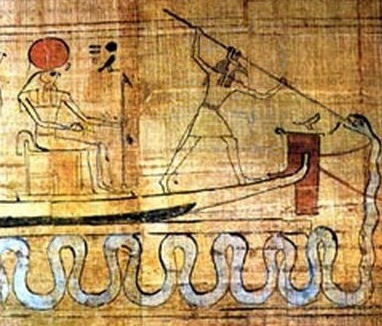
The celestial boat of Re encircles the sky to continue the idea of time being generated by movement, and not so coincidentally, Re enlists the services of Set, who stands at the prow of the celestial boat ready to fight all who dare to halt this procession. The serpent Apophis is the great danger representing inertia, who is intent upon swallowing this barque of Re's, and returning all to chaos. 

VII: A. Piankoff, N. Rambova, Mythological papyri, New York, 1957, Plates volume, pl. 2.
21st Dynasty Book of the Dead, Egyptian Museum, Cairo

Re symbolizes the creation and path of cyclical time, but it is the strength and power of Set who is the force that propels and sustains the journey. Ultimately, the goal of the soul is to transfigure into an incorruptible form who no longer incarnates cyclically into matter as he becomes a pure and shining Akh not in need of further cleansing in the waters of incarnation. Armed with this knowledge, it can be seen that the ancient Egyptian process of mummification, and its association with Osiris, is clearly illustrating this metaphysical concept. The mummy is representing the incorruptible which not even death, the separation caused by Set, can lay waste to.

The mummified Osiris

Time is not all we suppose it to be.

Friday, January 18, 2013

the contendings of Horus and Set

The following is the ancient Egyptian tale of the eighty-year war between the gods Horus and Set and my personal interpretation of the myth. My on-going study of the myths of the Bible influence my perception of this tale to a large degree with the understanding that this story would precede the myths of the Bible. 

This is a tale from the Chester Beatty Papyrus No. 1 dated to the time of the 20th dynasty under the Pharaoh Rameses V, though the story is probably from earlier in New Kingdom ancient Egypt. It is a story of the fight between Horus, the son of Osiris, and Set, the brother of Osiris, over the office of the white crown of Osiris following the murder of Osiris at the hands of this Set.

The Hedjet - white crown of Upper Egypt

The story recounts their continuous battles and the attempts by the gods of Egypt to put an end to their fighting and adjudicate between the two. It casts the gods' deliberations in the context of what you would expect from mortal men's deliberations in that there are calls to adhere to tradition, sulking, trickery, and appeals to elders who may have some authority to sway the proceedings one way or the other. It is up to the cunning Isis to trick Set into incriminating himself that puts what seems to be an end to the proceedings only to see the infighting continue. Eventually, the candidacy of Horus cannot be denied as he proves himself worthy of the crown.

A few things to keep in mind about the story is first of all it is a fight over the white crown which Osiris wears. Osiris presumably had to give up this crown or a better explanation would be the power inherent in the headdress because he was no longer present in the land of Upper Egypt to effectively rule over it. After his murder, he was inert in the "land of the dead" and now ruled that realm. The luminous white crown he wears, the Hedjet, was the crown of Upper Egypt. Upper Egypt could refer to the southern half of the kingdom which was divided at the royal city of Mennefer, known to the Greeks as Memphis. As an aside, I wonder why the Egyptians did not correct the Greeks in their terrible translation of this name into Greek? Perhaps the contempt they felt for them caused them to let the Greeks continue in their ignorance? In any event, I think it is important to consider a different explanation for the location of Upper Egypt in this case. Because the ancient Egyptians believed their land to be a personification of the heavens, it is possible this designation is referring to the night sky. Osiris as Orion would wear the crown while ruling over the southern half of the night sky. Upon Osiris' death, which is Orion's disappearance and descent into matter, the fight for his crown would commence once Isis had magically revived Osiris in the "netherworld" in order to be impregnated by his seed and give birth to his son Horus. In the meantime, the crown would be vacant from the time of Osiris' murder until the birth of Horus. During this time the combatants would try to back up a claim to the throne. Consequently, if Set hadn't already been locked up for murder, he would have a pretty strong claim on the crown. While in the "netherworld" Osiris' crown was the Atef, a Hedjet crown surmounted by two ostrich feathers; the ostrich feathers seemingly denoting being entombed in matter.


Osiris wearing the Atef crown

The court proceeding takes place before the great Ennead of Iunu (Heliopolis of the Greeks) with the great Universal Lord Re presiding over the deliberations. The epithet "Universal" I understand as being manifest creation. The Ennead wants to award the crown to Horus however Re is not consulted about this preference and gets testy about the whole affair, wondering how the Ennead can award the crown without his input? Apparently, the Ennead used the rationale that since Thoth could present the uninjured eye, the Wadjet or Eye of Horus, to the Universal Lord Re, he speaks for the Ennead and has the authority to make this decision. This sacred eye is one of the disks that encapsulates the light and is encircled by the serpent goddess Wadjet, who is an aspect of the great mother goddess Hathor. Thoth, the wisdom of the light giving moon in the dark night, is the power that heals this eye in the darkness of existence. The cycle of the moon where it waxes and wanes, injured by the black pig Set, and then healed is to what this refers.

Wadjet Eye / Eye of Horus

Set wishes to prove his physical dominance over Horus and thus establish his claim on the crown while the Ennead appeals to tradition where the son should inherit the position of his father. As a solution, Atum suggests that the "great living god" Banebdjedet be summoned to judge between the two. Banebdjedet is the primordial ram headed god of Mendes who is frequently depicted with four heads - Re, Shu, Osiris, and Geb. He is lord of the Ba, in essence the god responsible for the creation of your immortal soul. The four heads are suggesting the idea that he is the world Ba of the four gods that make material life possible. Banebdjedet arrives at the gathering with the god Ptah-Tatenen. It seems surprising that Banebdjedet does not immediately side with Horus, as Horus is the re-born Ba soul of Osiris via Isis. Maybe it is the presence of his sidekick Tatenen that convinces him this matter should be escalated to another authority? Tatenen seems to be an aspect or complement to the more spiritual Ba realm of Banebdjedet. The four heads of Banebdjedet could be an allusion to Tatenen, an expression of Ptah, who instead of being latent mummified creation like Ptah, has come forth as creation. In fact, it is Khnum, the potter of the Ka life force, who is the father of Tatenen and who created Tatenen when the earth came into being. Tatenen would be the great Universal Ka which is sustained by the Universal Lord Re. A role of Tatenen, much like Set, involved keeping the serpent Apophis away from the primeval mound of the earth. Set's incredible strength thus far has enabled the created world, of which Re is Lord, to also fend of the advances of the serpent Apophis who threatens to annihilate this creation. Without the services of Set, Re fears creation will not last and it seems likely that Tatenen feels the same way, though not explicitly demonstrated. Without creation, the Ba cannot incarnate and become a glorious Akh; therefore, these Ka powers are of the utmost importance. Instead, Banebdjedet asks Thoth to send a letter off to the primordial mother goddess Neith, the mother of the great light which rises from the Nun, "in the name of the Universal Lord, the Bull who resides in Iunu". Re is recognized as the manifest sustainer of the universal Ka provider, the Bull, who gives and provides for all of creation.

Banebdjedet receiving an offering from Prince Mentuherkhepshef
By Kairoinfo4u photographer: Manna (http://www.flickr.com/photos/manna4u/3331554556/) [CC-BY-SA-2.0
(http://creativecommons.org/licenses/by-sa/2.0)], via Wikimedia Commons

Tatenen

Thoth's letter on behalf of Re gives quite a list of epithets of Re with the description of Re being the manifestation of the Universal Lord giving us the relationship between Re and Atum. Atum being totality, becomes Re when he has come forth in creation. Neith responds by saying the only outcome has to be Horus gets awarded the crown of his father. So that Set does not go away empty handed, he should be given two daughters of Re - Anat and Astarte. These two are aspects of the mother goddess and will allow Set to continue to populate the world with his beastly offspring.

Set seems to be an aspect of Re in that they are both related to the power of the Ka and the life force. Re is the creator of the material world and supplies the necessary sustenance to feed his creation as well as animating this world with his gift of Ka power. It is Re who fights for the right of Set to assume the kingship of the united Egypt after the death of the kingly Osiris; this unity being a metaphor for the fight and unification that goes on within every human between the beast and the spirit in you. It is projected onto the Egyptian kingdom and their myths. Some historians and archaeologists look for traces of a prolonged battle or create narratives of a historical battle between the followers of the Horus religion and the followers of the Sethian religion rather in vain due to the failure of our generation and many generations before us to take myth as hidden spiritual truths. Along the same lines, the Bible becomes a joke to most rational minded people due to this misunderstanding. Anyway, when it appears that Set will not be granted the right to rule as Neith feels the only possible true outcome is to award Horus the crown, then Re gets all pissy, has a snit, and lies down and mopes about until Hathor comes along and flashes him her genitals. This jovial gesture by the Goddess seems to reinvigorate Re to once again continue on his way and provide life. Re prefers Set over Horus because Set is the personification of this raw Ka power on earth in that he is full of strength and untamed. Because of this untamed instinct, Set is the beast that kills off the Ba soul that incarnates into the world as Osiris.


Set

I wonder if that is connected to the role of the beast Satan in the Christian religion? Satan tempts us in to following our carnal and selfish instincts, having no regard for our spiritual side with the difference being this beast seems to be in charge here on earth until Jesus returns to give him the boot. It is where I tend to get confused on the issue. I was under the impression that Satan ruled the place where the bad people go, Hell, and not the earthly realm. But by inference it always seems that it is Satan here in this realm who is responsible for all the calamity in the world. So, it is really not fair then, right? If Satan is here tempting us then it isn't a fair fight and we are all going to lose. Wouldn't it be a more fair fight if Satan was just relegated to Hell and we get assigned to Hell only if we are naughty on earth due to our own evilness that is not helped along by some force that you can't resist anyway? Well, sorry to confuse. The situation would be much clearer if we did realize that these two opposites are encapsulated within the totality we call I/me/myself. In my version of Christianity, this Jesus within us descends from the heavens and has a battle with this Satan in our own personal Hell. If Jesus wins then we are born again, get off the wheel of incarnation, and listen to harp music for the rest of eternity. If the devil gets the upper hand then upon material death we go back to incarnate in this earth hell for another round, hopefully using the innate knowledge now within us to be more successful this time around.

So, it is because of this that I think Satan should be properly thought of as a creation of who the Christians call Yahweh or the Lord. In the Old Testament, it is Yahweh who creates the red or ruddy man. The name of the first man, Adam, comes from the Hebrew adam, meaning ruddy. Then we have the birth of Cain, a man that Eve said she got from the Lord Yahweh. Cain is a beast who kills the nice guy Abel. Esau, the older twin of Jacob is often connected to the red beast and even called Edom, the Hebrew word for red, in Genesis 25:30. It is this entity that we constantly fight with and causes our suffering. I challenge you to re-read the Book of Genesis with this motif in mind and let the Bible come alive for you as a guide to your inner life. It is our desires that are constantly at war with our enlightened self. These desires do win out in the beginning because they are stronger; to a degree they are impossible to control, especially in our early life. As we get older and these desires do start to wane, our spiritual self can experience an awakening of sorts and finally achieve some kind of balance; maybe even get an upper hand on this relentless beast.

So, back to our story after a little theological break. Upon hearing Neith's decision, Re becomes furious and claims Horus is too young to hold this office with his insult, "the flavour of whose mouth is bad" which is an allusion to Horus still being an infant suckling at the breast of Isis. It is an ancient way of saying, "You Suck!" This in turn infuriated the entire Ennead, with the monkey god Bebon telling Re, "your shrine is vacant" which in essence is saying time has passed you by, you are out of touch, and we don't need to listen to you anymore. I think everyone feels that about their parents at some point when they are coming of age. At this insult Re takes considerable offense and lays down on his back sulking. In damage control the Ennead tells Bebon to get lost because of this grave injustice he has done to Re. If Re doesn't do his duty and animate creation then life will cease to exist. Presumably, the earth was in darkness due to the light of Re not shining; so, it was up to Hathor to flash Re her vagina in order to enliven him and once again get him moving. This act seems like a jovial gesture to to try to lighten the mood and get everyone civil again. I think it deserves a closer look. Hathor, in this instance is the dawn of the morning that precedes the coming forth of Re from his nightly trip through the Duat. Hathor flashing Re her vagina is showing him the path to rebirth into the akhet, the ancient Egyptian term for the place of cyclical rebirth, thus opening the way for Re to be reinvigorated and continue his cyclical journey. From this act, Re remembers his purpose as the Universal Lord and is enlivened to continue on his daily course.

Cooler heads prevail and the two warring parties are given a chance to state their case before the council. Set once again appeals to his strength in helping Re continue on his daily travels without interruption while Horus appeals to the tradition of the crown being passed down from father to son, as in Re passing it to Shu to Geb to Osiris and now to Horus. It is now Isis' turn to get angry but she is calmed by the Ennead who say that what is right will be done. This in turn enrages Set, who claims in retaliation he will everyday kill one of the members of the Ennead and refuses to remain in deliberations while Isis is around. The way the gods act is very immature with their histrionics and fits of rage. However, as the Ennead of Iunu are representing forces of nature, in a way it is to be expected as nature at times tends to rage and is unpredictable, especially when we get lulled into expecting everything to continue as it has in a nice cyclical and orderly pattern.

The Ennead ferry across to an island to reconvene with the ferryman given explicit instructions to not bring Isis across. Isis, of course, tricks him, gets across, and turns herself into a beautiful maiden which attracts the advances of Set. Isis concocts this story where her husband had died and her son took over tending to the cattle on the land. A stranger eventually came and lodged with them in exchange for helping out. His plans were nefarious as he eventually tells the son he will beat him and confiscate the cattle. Reacting to this tale, Set said that the man should be evicted and the son put in his father's position, thus incriminating himself. After Re learns of this trickery and Set's subsequent confession, Set takes out his rage on Nemty the ferryman who has the fore part of his feet removed as punishment. This also is a nautical term describing the part of a ship where the prow joins the keel, which is very apt in the case of the ferryman.

As a result, Pre-Harakhti (another name of Re and Atum) Lord of the Two Lands and "the Heliopolitan", write a letter to the Ennead awarding Horus the White Crown at which Set once again becomes enraged. Set wants the crown removed from Horus' head and Horus thrown in the water, upon which they will both transform into Hippopotami and submerge. Whoever comes out of the water prior to the end of the three months will be the loser of the contest. Re agrees to this contest, even after all that has happened, apparently still wanting to see Set take over the crown of Osiris. Isis figures her son Horus is a goner and magically fashions a harpoon and casts it into the water at Set but instead hits Horus. She then tosses it and hits Set, who appeals to their relationship as brother and sister in order for Isis to release him. She does and Horus now flies into a rage, takes his axe and cuts off Isis' head with it. He takes the head in his arms and climbs the western mountain. Isis transforms into a headless statue of flint and upon seeing this, Re gathers the rest of the Ennead to go find Horus in order to punish him.

This strange turn of events seems to come out of nowhere. Horus is supposed to be the good guy yet here he is cutting off the head of his mother. I'm tempted to chalk this up to the coming of age of Horus and the need to separate himself from the maternal mother figure. There comes a point in life when it is necessary to leave home and strike out on your own however it is usually done in a more civil manner. In a way, it is represented as the youth still being immature and unable to quite yet handle his growing strength. As well, there is some allusion here to the cycles of the sun and moon and their relationship to the increasing power of light after they come out of the waters of incarnation. The sun at the winter solstice will stand still for three days before reversing course and starting to grow in strength in its journey to its zenith at the summer solstice. The moon will disappear for three days into the water before emerging as a new moon on its way to becoming a full moon. The three months in the water as Hippopotami is possibly symbolizing this aspect of the two great celestial orbs. The heading up a mountain after coming out of the waters of creation is the behaviour of the earth's sun and moon after rebirth. Now as to Horus cutting off the head of Isis and carrying it up the mountain, there are some echoes to Greek mythology here in this story. This ancient Egyptian story predates those myths and has a more favourable outcome for the one who loses her head in the story. The Greek myth of Perseus is what I am referring to. Perseus is a son of the great ruler Zeus and is tasked with bringing back the head of the Gorgon Medusa, who when you look at this wild snake-haired maiden she turns you to stone. Perseus, with the help of Hermes and Athena, is able to approach Medusa and cut of her head with his sword. He assumes the position of Horus the Striker as the hero in the northern night sky as this picture of his constellation is showing:


Perseus with the head of Medusa

The similarities of the two stories are the cutting off of the head with the sword, the tucking it under the left arm, and then there is Isis afterwards turning into a stone statue as opposed to turning all that look at her into stone. As well, it is Hermes and Athena who help Perseus on this quest. Hermes is the Greek iteration of Thoth, and Athena is the Egyptian Neith and as we have seen, Thoth as the personification of earthly wisdom and Neith, as a supporter of Horus' claim to the crown, play supporting roles in this tale. Obviously, the story changed when it became the young hero Perseus' myth however it is nonetheless interesting to see some of its connections to the myths of ancient Egypt.

So back to the story, Horus climbs the mountain with the head of Isis; climbing the mountain being an allusion to the celestial orbs rising in the sky, and rests under a tree. Set finds him first and gouges both of his eyes out and buries them in the mountain. The two eyes grew into lotuses which is apt since the lotus gives birth in the morning to the great child of light. Set then runs into Re and tells him the lie that he had not seen Horus. Hathor finds Horus and she heals his eyes with milk of the gazelle; the gazelle sometimes being a symbol for Set. In this aspect, Set gets the epithet "robber of the eye". Since milk has healing properties, Hathor uses a little reverse medicinal psychology! The Ennead once again summoned the two and told them to make peace. Set invites Horus over to make amends and at night while they lay down to sleep, Set tries to penetrate Horus sexually, presumably to demonstrate that he is not a real man. Horus took Set's semen in his hands and told Isis what happened. Isis freaked out and cut off his hand and then proceeded to masturbate Horus into a pot which they then poured onto the lettuce that Set normally eats in order that it is Set who will receive Horus' seed. The two then went back before the Ennead and Set boasted that he had sodomized Horus to which the Ennead spewed and spat at Horus' face, as even back then homophobia was just as prevalent. Horus calls Set a liar and gets Thoth to summon the semen of each participant to see who is telling the truth. Set's semen answered from the marsh that Isis threw it in after cutting off Horus' hand while Horus' semen answered from within the pregnant Set. Being divine seed, the pregnancy appeared on the top of Set's head as a golden solar disk. Thoth grabbed the disk and placed it on his own head. This actually has great esoteric significance. It is signifying that when the reawakened young soul represented as Horus struggles to mature and assume his destiny, all the while fighting his nemesis Set, who is representing desire and temptation, the successful result of this is wisdom. Wisdom will be born out of the simple beast who you have subdued.

Though you might think this would settle the question once and for all, Set is able to convince everyone that there should be one last battle, this one being a race of stone ships. Set feeling he is the stronger of the two, wishes to demonstrate this strength and be awarded the crown. However, Horus is now cunning enough to treat a stone ship as a ship that hauls stone and builds his ship with pine plastered with gypsum. Come race day, Set's boat immediately sinks and out of frustration he immediately scuttles Horus' boat. This infuriates Horus who is about to harpoon Set when he is told to stop.


Horus harpoons Set from the Temple of Horus at Edfu

At this point, Horus has finally had enough and sails downstream to Sais to petition Neith to put an end to this fighting which has gone on for eighty-years and make the case that he has been vindicated every time. The designation of eighty-years is a bit of a mystery. If this myth is indeed a story of the inner struggle within you, I would have to believe this refers to the eighth stage of light's journey into and out of matter. The eight symbolism would be rebirth as Horus from the goddess Isis which would have followed the seven, which is the resting in matter as symbolized by Horus' father Osiris. The rebirth of your enlightened self is only a beginning of sorts and it is still an uphill climb up the mountain to subdue this beast and ultimately reconcile the two halves of yourself. This would lead to the ninth stage of the journey at material judgment represented by the scales where your heart is weighed against a feather. Being able to balance your two warring selves, Horus and Set, is the way to pass this judgment. There is not an expectation of a sinless, completely virtuous life but rather a recognition that the journey into matter will cause strife. As was shown in the scene with Thoth taking the golden disk from the head of Set, the constant battles which you are faced with enables you to grow stronger and acquire great wisdom which you then use to end this fighting for good with the knowledge that you are now complete and fully vindicated.

Horus, Set, and the ruling Pharaoh in balance

The Ennead now has Thoth draft a letter to Osiris asking him for a final judgment, which is fitting because Osiris sits on the throne in the judgment hall awaiting the vindicated as Horus following the weighing of the heart in which Thoth is there recording the judgment in the book of life. Osiris is fully addressed with all the names of kingship, showing deep reverence for him. Osiris answers immediately saying his son Horus should not be cheated and that all the gods should be grateful for Osiris' sacrifices because without him there would be no rebirth or sustenance. Re takes umbrage to this statement and immediately retorts that without Osiris there still would be grain. This seems to be a question of who is responsible for sustenance on the earth. Is it Osiris, the fertile bull who gives up his own existence so that grain can rise from the earth in its due time cyclically every year or is the light of Re that causes the grain to rise, in essence suggesting that without him it does not come forth? Osiris responds that what Re does is indeed important however he has allowed injustice to get the upper hand and that himself, Osiris, lives in a dark word where injustice abounds and they don't fear the gods; so, it is up to the gods to administer justice whenever they can. Osiris concludes by saying there is none greater than himself as he has made the ultimate sacrifice so others can live. He is being true of speech and not boasting.

Following this, they reconvened on the Island in the Middle whereby Horus is vindicated and Set brought in chains before the court. Set finally acquiesces to the decision and Horus is awarded the White Crown. His kingdom truly has come. The mature light of Horus is finally ready to assume the kingship of Egypt and now illuminates the world, giving hope to all. Re gives Set a place in his entourage as a son who will continue to use his strength to fight off the advances of the destroyer of creation, Apophis.


Set on Re's solar boat, fighting off Apophis

Thus concludes the story.

To read the story in full go to this link: