Translate

Showing posts with label Sekhemet. Show all posts

Monday, February 21, 2022

he who is in you is greater than he who is in the world

The truth is I’m the bad guy and he’s the good guy. I treat him as the adversary because he is in opposition to my worldly paradigm of fulfilling my wants and desires. This meat carnival is so inviting and I want my fill. That inner compass, whether moral or just a friendly reminder of the consequences of my actions, I have to bury. He is always there. When I set out to fulfill my desires, I assign the tumult to him in order that I have someone to blame.

I get why people seek an external Jesus. We get an inkling of the spirit and split within us and we are conditioned to find what we are looking for in the external world. Or, we can’t accept that little old us can house a god within. The sages of yesteryear shout at us to look within. So, we look within and initially all we find is a box of repressed feelings, desires, and instincts. It’s quite the project to go even deeper and polish the pearl which lies within the depths of this buried panoply.

Why does Jesus hang out with thieves and whores? Because that’s where we place him. We shut him away in the darkness where we shove all the things about us we hide from society and culture at large. You are the thief. You are the whore. Becoming an atheist means we don’t have to contemplate the inner voice. Becoming a Christian means we can externalize that voice and let some other human power lead us astray and delay the eventual reckoning.

Why do we crucify Jesus every year? Because in order to live this life of desire fulfillment we have to get him out of the way. So, we hang him on a cross and go about our business, free of his interference. He dies for your sins - an ingenious way of transferring responsibility onto the other. Remember, you think you’re the good guy. Jesus subsequently returns and harangues us. Imagine that! Like Peter, every year we have to deny him. 3 times until the cock crows. I know not the man. Please go away, you’re preventing me from living my best life. He doesn’t take the hint; so, once again we point him out to the authorities and hang him on the cross. If you live long enough, you must wonder what’s going on? Imagine being a billionaire, living it up, and every year the light grows within you and you have to abort or pretty soon you are giving away your fortune and helping others.

There’re many names for the god within. The ancient Egyptians called him Amen-Re and he rose to prominence in the Pharaonic 18th dynasty. Amen-Re means hidden light and it’s within where you will find the light. Pharaohs adopted the moniker Amen. Amenhotep - Amen is peace. Tutankhamun - The living image of Amen. You can find him in the devotionals of the commoner of the time who called upon the god in a display of personal piety. My culture calls him Jesus but we don’t teach to look within. There would be no need for our religious institutions if everyone knew of the hidden kingdom within. So, we have churches and tightly controlled religious experiences.

In the third millennium BCE, the ancient Egyptians credited the great Imhotep for the progress of civilization. The pyramid complex at Saqqarah and advances in medicine were all because of him. He was said to be a demi-god - the son of Sekhemet, who was the ferocious healing aspect of the Great Goddess Hathor. Imhotep means, “I come in peace.” Do you see it? Are you picking up what I’m putting down?

What a long journey to get to this place coinciding with publishing a blog post recognizing that I met Jesus. I’ve been sitting within myself, alone, for a couple days now and the epiphany hit. It was a gradual build up just waiting for the catalyst. It was a YouTube username that was the incendiary spark. He who is in you is greater than he who is in the world.

I have written a few times about how I felt Jesus was an avatar for the weak. It’s true, but only in the sense of the external Jesus. The one we invented out of whole cloth and projected out onto the world at large. The neutered power by which others profit. In essence, stealing the power that we all hold within. Hanging on to the image of an external Jesus will prevent the inner exploration that makes you come face to face with who you are. When you meet yourself, trust me, you will run. When you accept who you are, you will be able to find within the hidden light in the labyrinth of self. It’s the treasure.

I know of who is in me. My mushrooms trips are all about the split. The last two months, well ever since I took 2 grams of magic mushrooms on December 1st, I knew I had to figure this out. I went deep into the shadow and laid bare the split. At first, I assigned to him the bad and I took credit for the good. I assigned to him everything I don’t like about myself. I deduced the split I intuited was me the good versus him the bad when in fact these two were both me. I just hadn’t reconciled with who I am. I wasn’t ready to have to take responsibility for the suffering in the world so I did what everyone else does and transferred it onto the other and externalized it. I'm the good guy yet I know I'm not. But I'm not that guy. Once I stopped the game of pretend and accepted I was also the guy with horns and the world is a reflection of what I have brought forth, I saw the truth.

I keep piling up shit and dirt upon him and then point and say he is the bastard. My god, he will wait forever until I wake up. The world is the training ground which allows us to manifest what we need after we get our fill. The human race is defined by conflict. We bury, pour dirt, and shit on the light within. Rinse and repeat. It gnawed away at me and I finally realized it was I who was the bad guy. I knew I could get the answer if I asked and then searched. I knew he’d tell me. He always does.

What a journey to get to this point. I am humbled. I also find this very funny. It had to be this way. I can’t accept anything on blind faith. I need proof and the methodology has to be self-approved. Like Frank Sinatra, I did it my way.

Monday, April 20, 2020

sekhem and huachuma

I received a reminder recently about ancient Egypt and the power of the Goddess, which is contained in their concept of Sekhem. This energy is the ultimate power in the universe that is used to generate and create. We get this definition of the power here from Egyptologist Dr. Ramses Seleem:

The Sekhem is the electromagnetic body, which circulates in and out of the human body, bringing in the five currents of earth energy to nourish the human soul.  This body is responsible for the healing of disease.  The physicians of ancient Egypt, were therefore, called the priests of Sekhemet.
The Illustrated Egyptian Book of the Dead, Dr. Ramses Seleem, page 94.

An aspect of Hathor, the Great Goddess of Egypt, is the raging lioness called Sekhemet that personifies this power. She sustains life and she can take it away, so for instance when the Pharaoh Amenhotep III was in declining health he commissioned hundreds of idols of the Goddess to be crafted in order to try and curry favour with her healing power. It is no accident that the great physician sage of ancient Egypt, Imhotep, claims as his mother Sekhemet. The rattling instrument called the sistrum that is used to call upon the Goddess was also known as Sekhem. The song brought into existence by the shaking of the sistrum creates the energy field which powers each individual soul. We are all notes of the eternal song.

Ihy - the child of Hathor with sistrum

A while back I wrote a blog post where I tracked the ancient Egyptian concept of the Ka power in all of us which is the life force. For most it is a latent and subtle power that animates you and without Ka you’re dead. During times of agitation or excitation you get hits of adrenaline where you notice you are full of energy which is the amplification of this power. Taking notice of this state of agitation allows you to get a better understanding of this power that courses through you and propels you on through life. Basically it gets you up in the morning but there is a limit to how you can experience it and a lot of people like to do death defying things such as skydiving or anything that gives you a rush because you feel that power and it is quite exhilarating. Sekhem is the source of the life force Ka power within us.

What I have noticed about the plant medicine Huachuma is it's a potentiator of the life force power within us as it amplifies pretty much everything. Once you start working with it you notice this effect and the first few times you drink it’s all new so your reaction is: what the fuck is going on? because everything comes alive and you start noticing nature and its wonder and glory; everything is much more vibrant as in actually vibrating and you feel the electrical surge within you. It’s pulsing energy that affects everything from your feelings, thoughts, and senses; right down to your physical form. A lot of the reaction depends upon your state and what you have previously cultivated. The biggest lessons I learned early on in this latest semester at SpiritQuest involved my constant struggles with being in my head, trying to get out of my head, and then into my heart. I’ve done it enough now that I have learned when I struggle with plant medicines it’s because I’m in my head and I’m thinking. Plant medicines take those thoughts and balloon them into crazy territory and fill you with thoughts of doom and gloom plus paranoia. This happens enough that you can start to work with these reactions and soon you realize externally everything is fine but internally you are struggling. Finally with enough lessons and practice you realize that if I am going to be in my head then I’ve made this choice to create hell on earth. You can extrapolate from the teachings your normal sense of day to day life where you are constantly using the mind and you're projecting and judging things; you’re creating the worst case scenario; you’re thinking of scarcity and am I going to survive and how am I going to get through this? You’re creating this hell on earth for yourself and it clearly shows you that in no uncertain terms so you do this enough and eventually you see this is what as a plant teacher Huachuma is going to get through to you. Now that I have drank seventeen times I realized I can remain ignorant for only so long before taking notice that Huachuma is teaching and it is not doing it in a way that is pounding it into to you but it’s just continually showing the student over and over again the choices made and their effects. The choices are realized immediately while you are in it and you can see obviously this is going to affect me in a subtler way when I’m back in my everyday world integrating my experiences. The opposite reaction lines up with the advice of the maestros and maestras who are looking at you telling you to get out of your head and get into your heart as that’s where you ultimately want to be. That’s a choice you make and even if you have trouble making it stick you still will say to yourself okay I will give this a shot because the head case model isn’t working; I’m going to get into my heart and I’m going to express love and see the beauty of everything around me and the beauty that is in other people. I’m going to stop judging them and just accept them for who they are and accept myself for who I am and that is also amplified to the point where you experience bliss and the best day of your life. It’s the best day you have ever experienced because you are in your heart. You are still challenged by your situation but within this unity and this love you feel for everyone, things just don’t matter and you realize that as long as I maintain this love no matter what happens we will always be there for each other and I can always find this piece of heaven by making a choice to live my life this way. There is the opposite reaction where you can choose to come back into the world and live within your head and create a hell for yourself. When you do make this choice you are able to at least be cognizant of it and then stop if you so please, get back into your heart, and start to live with this abundance of love for everything. This power unlocked by the plant medicine is a great teacher.

That’s what Huachuma in its classic teaching does for you but it goes further still. It is a potentiator but I have also noticed that my energy can be juiced after coming forth as masculine energy. I have found that if you can harmonize with another energy field, feminine in my case, then the feminine is what the ancient Egyptians call Sekhem power or the Shakti/Kundalini serpent power of the Hindus. Huachuma potentiates energy and when you harmonize with another's energy field it is a multiplier. The energy I’ve described as serpent power harmonizes with your store of power. The combination then courses through you and personally it goes into my heart and starts my heart fluttering like crazy which is the most ridiculous feeling of so much power that I have ever come across. I’ve only ever been able to do it if there is in the setting this abundance of realized goddess energy within my sphere of influence. I’ve been in Huachuma before when there hasn’t been this energy around and it’s been like a blissful good day but it hasn’t gone the extra step that goes beyond the boundaries of normal experience. The two sacred energies harmonize as one. I can feel it just enveloping me and I know from approaching others and touching them or sharing the energy that they can feel it as well. It leads me back to what I did learn from studying ancient Egyptians and how they discerned this available energy. They were bang on in describing it as this raging energy that comes from the Goddess and when you access it and then are able to become a conduit for it then it is intoxicating. Since I’ve returned home I have missed it so much and am eager to return and just explore the energy. It’s not like a drug where you want to live permanently in that state rather I want to know and understand it better with the eventuality of sharing it with all.

I remember having a taste of this the first time I ever drank Ayahuasca in the form of the coming of the Goddess and I commented afterwards that men who find this Goddess I could easily see spending the rest of their life trying to make the connection again. This energy has appeared for me again as the Goddess in some Ayahuasca ceremonies but not all. It’s a good reason why I stayed on this quest despite hardship; knowing that she might reappear. Huachuma in the proper set and setting is my way in now to consistently channel her energy. 

Friday, May 27, 2016

windowing into ancient egypt

The eye of Horus is a representation of the energy contained within the waxing and waning of the moon which is feminine Goddess energy.

Eye of Horus

The two ubiquitous ancient Egyptian eyes, left of Horus representing the creative feminine right brain lunar energy, and the right of Re representing the analytical masculine left brain solar energy, are both serpentine goddesses. Wadjet, an emanation of the goddess Hathor (literally the house of Horus), is the serpentine left eye while the raging goddess represented in the form of the lioness goddesses Sekhemet (Hathor's wild and destructive side) or Tefenet are representative of the right eye.

Wadjet as a cobra with Horus as the lion king

Sekhemet from the temple of Hathor in Denderah

Horus is the distillation of wisdom and light, born of the goddess Isis (the womb for the soul in the material plane) and her husband Osiris (Osiris is the eternal light that comes here and dies upon incarnation into matter). The birth of Horus is your story of awakening to an understanding of whom you really are. Feminine energy, which is love, reconstitutes the light soul which you literally see in the moon as it grows and thus the eye of Horus is fractional journeying towards wholeness.

Eye of Horus representing fractions

The full moon is expressing the maximum light this vessel can hold and at this point you can transfigure yourself into a pure luminous being of light and transcend the material plane. If you cannot, then the light is attacked by the powers of darkness and you head back cyclically for another incarnation, just like the moon.

The right eye, the eye of Re, is the distillation of the masculine force that is the impetus that propels us onwards in our journey in the physical realm.

A bracelet of pharaoh Sheshong II depicting the Eye of Re

Re as represented by the cyclical path of the sun is demonstrating the relentless and goal oriented resolve to complete the daily task of the rising and setting of the sun. The Goddess that encapsulates the spirit of this eye can rage at times and cause much destruction in her wake. In ancient Egypt, we have in their myths Sekhemet coming down to destroy mankind at the behest of Re and also the story of the goddess Tefenet leaving the land of Kemet in a huff, and departing for Nubia to which the gods Shu and Thoth are sent in order to bring her back to Egypt. These tales are presenting how destructive masculine energy can be (think war) if not channeled into a more beneficial state. 

As represented by the eyes, within each of these individual paths contains the dualistic notion of the feminine and masculine. Within the eye of Horus are the feminine Hathor, who exudes a soft feminine vibe, and the masculine Horus, who grows up to be an enlightened ruler. This is also true of the eye of Re, where paired with the masculine Re is the feminine counterpart Sekhemet. Much like Re, Sekhemet can be unpredictable and rage. These two Goddess serpentine eyes who are representing the feminine and masculine principles, the yin and the yang, reveal to us that in the ancient Egyptian cosmology it is ultimately the feminine who is the impetus behind the forces which enliven and enlighten the material world. These two eyes are referring to two paths which present themselves to the seeker of higher knowledge, and these paths must be reconciled to each other in harmony in order for the adherent to progress on their spiritual journey. It can be thought of as the alchemical union of the soul and the spirit, the heart and the mind, love and light, Sophia and the Christos, wisdom and the Logos, Mary Magdalene and Jesus Christ, Beauty and the Beast, the idea of the sacred union called the Hieros Gamos, and so on. At its core is what the higher practice of shamanism is all about - the reconciliation of the opposites. The same principle was the guiding light behind the alchemists of the middle ages in their search for alchemical gold. The true practitioner of this esoteric art was indeed searching for the magical elixir of transformation that a combining of the feminine and masculine would constitute. The moon and the sun as two distinct paths can be harmonized in the middle as an axis mundi of sorts, and the result is a transfiguration of the soul in a process the ancient Egyptians described as becoming an Akh. The Akh is a transcended soul of pure luminous light, usually depicted as a white jabiru stork that has the connotation of wisdom reflected in the form of the lunar god Thoth.

The luminous Akh

Within the ancient Egyptian cosmology is always iconographically present a reminder of the dualistic paths of life which must be reconciled in order to master this class we call consciousness. The eyes we see depicted in their art are another striking example of their eternal genius.


Thursday, July 9, 2015

lady of terror, lady of life

Continuing on with the topic of the life force which is called Ka in ancient Egypt, Qi in Taoist thinking, Prana in Yogic systems that references the Kundalini power resident in all, and the Nephesh in the Torah, there would be different levels of this power resident in the physical body that would determine your energy. I'm always reminded of a puppy when thinking of something that is full of this power. The ancient Egyptians would represent it iconographically as a bull; a bull being an excellent example of this coursing energy.


They would also represent the power as food material as the ingestion would reinvigorate your levels of this energy. As we age this power within us wanes, we start to lose the ability to fight off sickness and disease, and our material bodies perish. Of course, the ancient Egyptians noticed this and with their ideas of duality constituting creation, and the division into male and female constituent parts, called the activeness of this energy Sekhem. The vitality of the energy, Ka, flows through you. In Greek mythology the closest connection seems to be the beautiful goddess Psyche.

Cupid and Psyche (1798) by François Pascal Simon Gérard

The rattling musical instrument that is sacred to the ancient Egyptian goddess Hathor, called a sistrum, is representative of the Sekhem energy.

Ihy with Sistrum at the temple of Hathor in Denderah

In the Amazonian basin, an indigenous shaman would use a bundle of leaves called a chacapa to control the flow of this vibrational energy during an Ayahuasca ceremony.

A bundle of leaves known as a Chacapa

The double crown of ancient Egypt could be known as the Sekhemty which denotes the power resident in the Pharaoh, who would be the master of Upper and Lower Egypt, which can also symbolize the spiritual and material worlds (the as above, so below concept).

Horus at Edfu wearing Sekhemty

One of the titles of Osiris, who is representing the soul coming to incarnate in matter and being left for dead, is "Great Sekhem" and this concept is reinforcing that the ultimate expression of power and greatness is resident in the soul and it is through the power provided by Sekhem that this is realized.

The god Osiris is frequently given the epithet "Great Sekhem" or "Foremost of Powers," and the sekhem is therefore commonly found as an emblem and a fetish in connection with the underworld deity.
Reading Egyptian Art, Richard H. Wilkinson, page 183.

As well, the Sekhem sceptre was held by persons making offerings at tombs and waved over the offerings to activate the Ka power which would re-animate the deceased in the next life.

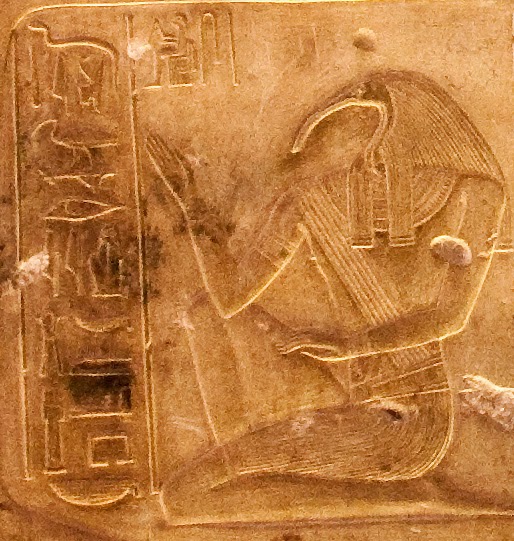
Seti I at Abydos with Sekhem sceptre

In the art of the ancient Egyptians, the face of divinity was for the most part never displayed straight on, always in profile, except in the case of Hathor and of the goddess Sekhemet. This is because the face of the god contained frightful amounts of this great power. The energy of the sistrum was derived from the face of Hathor.

For, as the Egyptians never tired of reiterating, direct contact with the face of powerful beings is dangerous, and again and again we read in prayers to a deity, 'May your merciful face be towards me'. In the face resides the kind of power called sekhem, which is also one of the names of the sistrum and is obviously linked with the name of Sekhmet 'the Powerful One'.
Hathor Rising, The Power of the Goddess in Ancient Egypt, Alison Roberts, page 57.

Sekhemet, the powerful one, is an aspect of the great goddess Hathor. (The Greek goddess Psyche, instead of being an aspect of Aphrodite, the Greek counterpart of Hathor, is mythologized as a rival to the beauty of Aphrodite.)

Sekhemet

Agitated water in a boiling state always brings to my mind the raging goddess Sekhemet. Her name is derived from the Sekhem which is essentially what you need to know about her power.


Sekhemet in hieroglyphics

Being full of this power, she is represented as a lioness; a raging source of animalistic energy who can create and also destroy. She rages; she brings pestilence and disease; and she can restore health to the sick. The great Pharaoh of the 18th dynasty, Amenhotep III, in his later years in seriously declining health, commissioned hundreds of statues of Sekhemet on the temple grounds, known as Isheru, in the form of the goddess Mut at Karnak in order to gain favour with Sekhemet so that she would restore health and vitality back upon him. She is a reminder that the difference between medicine and poison is all in the dosage and a clue that the healing action of medicine is essentially targeted energy that directly affects the compromised life form. Sekhemet is the patron goddess of physicians and the priesthood dedicated to her were all accomplished doctors in their own right, thus the epithet of Sekhemet the "lady of terror" could become the "lady of life". When seated in a statue portrayal, Sekhemet is shown holding the ankh; the symbolism being she grants life by activating the Ka power inherent within all life forms and thus animating creation. This would apply cosmologically on a grand scale or the power resident within you and I.

Sekhemet sitting at the Louvre

Sekhemet as the "lady of terror" can be compared favourably to the Hindu goddess Kali. Kali comes from the Sanskrit conception of time which is kala and the connection is that time leads to death which in the material plane is inescapable. If you are ignorant of your divine origins then the idea of death and dissolution is indeed terrifying. A cursory look at Hindu mythology demonstrates parallels with the idea of the Sekhem powering the Ka that I have been expounding upon in this entry. Shiva, who does the dance to propel creation along and at the same time is causing its destruction, is said to be powered by his wife Parvati of whom Kali is an aspect. This image shows the superior power of Kali over that of Shiva which parallels the idea that Ka power is nothing without the Sekhem.

Kali dominating Shiva

When depicted standing, Sekhemet holds a papyrus scepter, a symbol of Lower Egypt, which represents the flourishing and verdant created material world as opposed to the symbolic spiritual realm that Upper Egypt can represent.

Sekhemet standing with Papyrus sceptre

The sun disc on her head is symbolic of her presence in the realm of time known as neheh to the ancient Egyptians. It is representative of the cyclical nature of the time paradigm which us creatures of the created world are subject to and these cycles of birth and death, and of creation and destruction, are universal principles known to the ancient Egyptians as Maat. Tellingly, another epithet of Sekhemet is "The One Who Loves Maat and Who Detests Evil." Statues of Sekhemet are found scattered throughout the ruins of ancient Egypt and the base materials used are traditionally igneous rocks such as basalt or granite; the volcanic rocks being a great symbol of the explosive and fiery nature of the essence of Sekhemet. In the 18th dynasty, upon the rise of the god Amun-Re to prominence at Thebes, the mother goddess wife of his, Mut, took on many of the aspects of Sekhemet. Amun-Re is the universal hidden light that illuminates creation and Mut is the great mother as Sekhemet who is the complementary aspect of this principle and powers that manifest in our world. Within all of us is this light that comes from the source and on a cosmic scale the light operates as the source of spiritual life and love. Their son Khonsu is the mummified child who has the latent power of a healer which is present within all of humanity.

Khonsu 

Taking this idea further, the celestial representation of these powers are Sekhemet and her husband Ptah; Ptah being an amalgamation of the sky and earth separated by the Heh gods. Ptah is the Greek Hephaestus, who is the great craftsman of the material world.

Seti I worshipping Ptah at Abydos

He does not create unless the raging power of Sekhemet is active within him just like Amun-Re does not bestow his light upon the world without the active feminine principle represented by Mut. The child of Ptah and Sekhemet is the beautiful child Nefertem; the Atum child who is the androgyne, the origin of all whose division enabled the ennead of Iunu (Heliopolis) to come into existence and form the material world we know and allowed the soul as Osiris to manifest into creation.

Nefertem

Sekhmet. Most distinguished of the lioness goddesses and consort of Ptah (or Ptah-Sokar) of Memphis, mother of Nefertem. An early reference in the Pyramid Texts credits her with conceiving the king of Egypt (who was often portrayed as a lion), and she is portrayed in the Fourth Dynasty as passing the life force to King Snefru.
The Great Goddesses of Egypt, Barbara S. Lesko, page 273.

The great Imhotep of ancient Egypt, the one who comes in peace, claims his heritage from the great powers of Ptah and Sekhemet. Imhotep was a teacher, sage, healer, craftsman/builder, and magician of the 3rd dynasty of such renown that he was elevated to a status of a demigod in successive generations in ancient Egypt.

Imhotep

The Greeks represented their patron of healing, Asclepius, as being synonymous with Imhotep. The iconic staff, emblematic of healing that us moderns have borrowed from the Greeks, is entwined with the serpent; serpent power representing the power to heal (and harm). Imhotep is the true historical pioneer healer who should be given his proper due and ultimately his power to heal comes from the great goddess Sekhemet.

The greek god of healing Asclepius with serpent entwined staff

The oppressive and destructive heat of the Egyptian mid-day sun was also thought to come from the powers of Sekhemet which further solidified her terrifying aspect. In this aspect, she was known as "Nesert" which means the flame. The "Lady of Pestilence" was also greatly feared because of the sickness she could unleash without warning upon the population. Another of her epithets was the "Red Lady", this moniker symbolizing her association with Lower Egypt and the desert fringes of civilization.

The long dress worn by the goddess is often coloured red, and one of Sekhmet's epithets was 'mistress of red linen' symbolizing either her Lower Egypt or her warlike nature. Sometimes her garment has a rosette pattern over each nipple and while this has been suggested to reflect patterns in the shoulder hair of lions it is perhaps more likely that the pattern reflects an astronomical symbolism of the 'shoulder star' of the constellation Leo which is marked in Egyptian astronomical paintings. 
The Complete Gods and Goddesses of Ancient Egypt, Richard H. Wilkinson, page 182.

This connection of the rosette pattern to the constellation of Leo is an enigmatic one. Perhaps it can lend some weight to the age old debate of the origin of the great Sphinx on the Gizah plateau and who it ultimately represents. The feline characteristics and plateau connections to Hathor do tantalizing suggest the Sphinx is Hathor in her guise as the lioness Sekhemet.

Great Sphinx on the Gizah plateau

Sphinxes were symbols of three great goddesses of the Mediterranean: Hathor, Astarte, and Isis. Hathor votaries declared her to be "the mother of the gods, and the creators of the heavens and the earth, and of everything which is in them." She assumed the powers of "every solar god." When Ra, the sun god, was displeased with humans he asked Hathor to slay them all. She did. In the Hathor style the hair divides into two equal curls falling below the shoulders onto the breast. The Hathor style is traceable to the Middle Kingdom of Egypt (about 2500 BC) and Sphinxes that wear their hair like Hathor are found in Crete, Hittite Anatolia, and Syria.
Book of the Sphinx, Willis Goth Regier, page 168.

Hathor's presence and worship at Gizah is well documented:

The southern side of the valley temple of Khafre (Chephren) at Giza is known to have been dedicated to Hathor, and the title 'priestess of Hathor' becomes common from the 4th dynasty on.
The Complete Gods and Goddesses of Ancient Egypt, Richard H. Wilkinson, page144.

The valley temple of Khafre at Giza records on its facade the names of only two goddesses: Hathor, representing southern Egypt, and Bastet, representing the north.
The Complete Gods and Goddesses of Ancient Egypt, Richard H. Wilkinson, page 178.

The ancient Egyptian name for the Sphinx on the Gizah plateau is Per-Hol which means the place of Horus. The ancient Egyptian name for Hathor is Hwt-Her which means the "House of Horus." Taking this idea even further, the Sphinx was known in the New Kingdom and onwards as Horemakhet which has been translated as "Horus in the horizon." But would you now be surprised if I told you that akhet is another name for Hathor as the dawn? This means the designation Horemakhet is describing Horus as the light appearing in the dawn, which is Hathor as the akhet, essentially the light emanating from the house provided by the Goddess. As well, the Sphinx forms the rising sun in the east between the pyramids of Khafre and Khufu:

Approached from the east-southeast, the Sphinx’s head appears on the horizon between the Khafre and Khufu pyramids, like the sun disk between two mountains in the hieroglyph “akhet” or horizon. 
http://www.aeraweb.org/sphinx-project/national-park/

Akhet in hieroglyphics

Once again, the idea is symbolizing the light rising from the mother goddess Hathor who is being represented as the Sphinx. The lion was regarded as the guardian of the eastern and western horizon and in the above hieroglyph for the akhet, lions could be substituted for the mountains. The Gizah plateau in theory should have two guardian sphinxes at the eastern and western gateways for the sun's entrance into and out of the underworld.


Two felines representing mountains

It cannot be overstated how important was the power of this Goddess to the ancient Egyptians. Horus is representing the Ba in ancient Egypt, the born again soul to us, which is the actualization or coming forth of the light that is inherent in all of us engendered symbolically from the remembering of the slain Osiris and subsequent impregnation of his sister-wife Isis. 

The Egyptian tree goddess (whether identified as Hathor or another goddess) is often shown dispensing water to the birdlike bas (souls) of deceased persons in later papyrus and tomb paintings. Interestingly, near the Giza plateau there still survived in the 1950s a deep and very ancient well in the midst of a grove of sycamores.
The Great Goddesses of Egypt, Barbara S. Lesko, page 84.

There is a myth about Sekhemet being sent to destroy humankind and ultimately pacified as alluded to above. Perhaps the Sphinx is a magical amulet at Gizah on a grander scale designed to keep her in a calm state! This aspect of terror continues today as in Arabic the Great Sphinx is known as Abu al-Hul, “the father of terror.” Sekhemet is associated with the "Eye of Re" that in one myth was sent to destroy humankind because they were not following the laws of Re and thus she was to reintroduce justice in the form of Maat. As an aside, you can see a parallel here with the flood stories of antiquity which concern the rebelliousness of man and the desire of the god(s) to punish them. The feminine principle is connected to water and thus a great flood comes to destroy them. Anyway, Sekhemet was sent to earth in the form of a lioness and the carnage began, soon threatening to destroy all of humankind. There was no stopping Sekhemet in her rage at this point. A solution was found by pouring 7,000 jugs of beer mixed with red pomegranate juice into the Nile, which now resembled blood. Sekhemet eagerly drank of this blood and became so drunk the eventual hangover lasted for three days. She awoke in a pacified state and humankind was spared. A feast day was established in which everyone drank beer stained with pomegranate juice in reverence to "the Mistress and lady of the tomb, gracious one, destroyer of rebellion, mighty one of enchantments."

From a personal standpoint I can see a connection with the terror of Sekhemet juxtaposed with her healing aspect in conjunction with psychedelic plant medicines such as Ayahuasca. The Ayahuasca journey at its core reveals the interplay of the masculine and feminine energies to the drinker, which to the non-initiated can be overwhelming and absolutely terrifying, but within this experience is this incredible ability to heal.

As I have shown, it was the Goddess in ancient Egypt who ultimately controlled the power within creation to not only give vitality to the life force that flows through all living things but she also powered the creation of the physical world. As Sekhemet, she healed and she destroyed. In addition, the Goddess' ultimate act was to enable the light within us all, known as Horus, to come forth. It is the destiny of all of humankind to realize our divine nature and to this we owe a debt of gratitude that can never be repaid to the unselfishness and love of the great Goddess.

Sunday, February 2, 2014

hex and hag

In conjunction with my previous blog post: mirror, mirror, on the wall that describes the relationship of the Goddess to the visionary experience I felt it necessary to comment on the role of the malevolent hag or witch that is also prevalent in mythological lore concerning witchcraft. To get started let's do some research on some concepts connected with witchcraft. Putting a magic spell on someone is the idea of a hex. The Online Etymological Dictionary gives the origin of hex as the following:

hex (v.) 
1830, American English, from Pennsylvania German hexe "to practice witchcraft," from German hexen "to hex," related to Hexe "witch," from Middle High German hecse, hexse, from Old High German hagazussa (see hag). Noun meaning "magic spell" is first recorded 1909; earlier it meant "a witch" (1856).

Dictionary.com gives these definitions:

hex1 [heks] 
verb (used with object)
1.
to bewitch; practice witchcraft on: He was accused of hexing his neighbors' cows because they suddenly stopped giving milk.
noun
2.
spell; charm: With all this rain, somebody must have put a hex on our picnic.
3.
a witch.

One thing that stands out for me is the pronunciation of hex as heks. In ancient Egyptian the idea of magic was attributed to a male deity named Heka. 

Heka

Magic was understood to be a force that was not necessarily evil; it could be used for both good and bad purposes. As opposed to a glitzy conjuring, the idea of magic was something more commonplace in the world of the ancient Egyptians. It was a force that gave life to objects and connected to the ancient Egyptian idea of the life force called Ka. Through the use of ritual, the ancient Egyptians hoped to enact the transference of this power onto objects or to animate a mummified body for instance in the ceremony of the opening of the mouth and eyes.

Opening of the Mouth and Eyes

A witch is commonly known as a hag and the mental image we get from the word hag is an ugly old woman.

hag (n.) 
early 13c., "ugly old woman," probably a shortening of Old English hægtesse "witch, fury" (on assumption that -tesse was a suffix), from Proto-Germanic *hagatusjon-, of unknown origin. Similar shortening produced Dutch heks, German Hexe "witch" from cognate Middle Dutch haghetisse, Old High German hagzusa. 

First element is probably cognate with Old English haga "enclosure, portion of woodland marked off for cutting" (see hedge). Old Norse had tunriða and Old High German zunritha, both literally "hedge-rider," used of witches and ghosts. Second element may be connected with Norwegian tysja "fairy; crippled woman," Gaulish dusius "demon," Lithuanian dvasia "spirit," from PIE *dhewes- "to fly about, smoke, be scattered, vanish." 

One of the magic words for which there is no male form, suggesting its original meaning was close to "diviner, soothsayer," which were always female in northern European paganism, and hægtesse seem at one time to have meant "woman of prophetic and oracular powers" (Ælfric uses it to render the Greek "pythoness," the voice of the Delphic oracle), a figure greatly feared and respected. Later, the word was used of village wise women. 

Haga is also the haw- in hawthorn, which is an important tree in northern European pagan religion. There may be several layers of folk etymology here. Confusion or blending with heathenish is suggested by Middle English hæhtis, hægtis "hag, witch, fury, etc.," and haetnesse "goddess," used of Minerva and Diana. 

If the hægtesse was once a powerful supernatural woman (in Norse it is an alternative word for Norn, any of the three weird sisters, the equivalent of the Fates), it might originally have carried the hawthorn sense. Later, when the pagan magic was reduced to local scatterings, it might have had the sense of "hedge-rider," or "she who straddles the hedge," because the hedge was the boundary between the "civilized" world of the village and the wild world beyond. The hægtesse would have a foot in each reality. Even later, when it meant the local healer and root collector, living in the open and moving from village to village, it may have had the mildly pejorative sense of hedge- in Middle English (hedge-priest, etc.), suggesting an itinerant sleeping under bushes, perhaps. The same word could have contained all three senses before being reduced to its modern one.

The hag comes from hex and always referred to the feminine in northern European paganism. There is the idea in this word of a hedge which designates a dividing line between two worlds. This fits with the idea of a goddess being at the transition points that intersect the world of the material from the world of the spiritual. In ancient Egypt the goddess Hathor would be present at all events of birth and death. She would have a foot in both worlds of spirit and matter and from this we get the idea of birth and death as forever intertwined. A birth of a baby into the material world involves the death of a soul inside the new beginning. The awakening and re-birth of the soul within the body involves a death to worldly pursuits. The final death of the body allows the soul to be freed to re-enter the home from which it came. These magical events are attended by these emanations of the feminine divine who sit at the crossing points between these worlds.

This idea of the feminine being present at the soul's apparent death and deliverance into the material world gave rise to myths that depicted her as an evil temptress aligned with the devil, the devil being the Lord of the material world. In Greek mythology the legend of the Gorgon Medusa is such a tale. 

Medusa

She was at first a beautiful maiden that seduced the soul into the material world (the stone) but as you got closer she became hideous and turned you to stone. Her hair being venomous snakes screams out to me her connection with the feminine divine you would encounter in an altered state. We find these ideas in the definitions provided here:

World English Dictionary
hag 1  (hæɡ)

n
1.
an unpleasant or ugly old woman
2.
a witch
3.
short for hagfish
4.
obsolete  a female demon

[Old English hægtesse witch; related to Old High German hagazussa,
Middle Dutch haghetisse]

Encyclopedia
hag
in European folklore, an ugly and malicious old woman who practices witchcraft, with or without supernatural powers; hags are often said to be aligned with the devil or the dead. Sometimes appearing in the form of a beautiful woman, a succubus is a hag believed to engage in sexual intercourse with sleeping men, causing severe nightmares and leaving the victim exhausted. Although viewed in most lore as the antithesis of fertility, the hag is believed by some scholars to be a remnant of primitive nature goddesses.
http://dictionary.reference.com/browse/hag?s=t
I believe the same ideas of the hag, witchcraft, the devil, and death are at work in the old fairy tale of Hansel and Gretel. In this story the witch lures the two children into her house after the hungry pair first find her house made of gingerbread and cakes in the forest. The witch locks up Hansel and enslaves Gretel with the intent to eventually cook and eat them. The children are representative of the paired soul that is incarnating. They left home due to the wickedness of their stepmother. The myth making here demonstrating it is the intention of the feminine to force the soul to incarnate. The pair only incarnate because they are lured into the material world. The oven that the witch will cook them in is representing the fires of this material hell. The witch is an emanation of the Goddess, a side of her that is terrifying because she births the soul into the material world. This world is unkind and threatens the soul with death. The Goddess in mythology has a terrifying side, whether that is for example Kali in Hindu mythology, Medusa in the Greek stories, or Sekhemet the raging lioness destroyer in ancient Egyptian lore.

Sekhemet

Gretel manages instead to shove the witch into the oven and burn her. The underlying idea here is the soul is freed from its enslavement in matter. The two find a vase full of treasure and precious stones belonging to the witch and then a swan ferries them back home across the waters. The treasure is the material wealth of the Goddess; the swan is associated with the idea of a hermaphrodite; and the waters are material incarnation that must be crossed to make it home. 

Venus sitting on a swan and accompanied by a hermaphrodite
http://digitalcollections.nypl.org/items/510d47e4-603f-a3d9-e040-e00a18064a99

The hermaphrodite is an interesting concept in mythology not understood. It is the pairing of Aphrodite and Hermes which in ancient Egypt are Hathor and Thoth. 

 Hathor at Kom Ombo
Thoth imparting magical formulae at Abydos

Here we have the goddess of love combined with the god of wisdom to make the hermaphrodite. The deeper meaning is one of the paired soul of masculine and feminine halves. When they unite, they sail over the waters of material incarnation and head back home to their spiritual abode. It was encoded in this story as Gretel and Hansel. We can find this motif in many other places and here are a couple that come immediately to my mind:

in a book called "The Yellow Cross", which is a story of the Cathars of southern France last stand against the Catholic inquisition who persecuted them for their perceived heretical beliefs, the author writes about this belief of theirs:

According to script Catharism the foetus was a creation of the devil which awaited its redeeming soul. Moreover, some Cathar versions of the Fall averred that the devil seduced the souls away from their heavenly home by introducing it a beautiful woman whom all the souls desired to possess.
The Yellow Cross, Rene Weis, pages xxiii to xxiv.

I believe this idea of theirs comes from the beginning of Genesis 6 which tells the story of the sons of God lusting after the daughters of men.

Genesis 6
King James Version (KJV)
1 And it came to pass, when men began to multiply on the face of the earth, and daughters were born unto them,
2 That the sons of God saw the daughters of men that they were fair; and they took them wives of all which they chose.
3 And the Lord said, My spirit shall not always strive with man, for that he also is flesh: yet his days shall be an hundred and twenty years.
4 There were giants in the earth in those days; and also after that, when the sons of God came in unto the daughters of men, and they bare children to them, the same became mighty men which were of old, men of renown.
5 And God saw that the wickedness of man was great in the earth, and that every imagination of the thoughts of his heart was only evil continually.

I have written a blog post called let the sleeping giant lie that goes further into this curious passage in the beginning of Genesis. Further to this idea we find in Hinduism a goddess called Kali, who as an emanation of Durga who comes from the Great Goddess Devi, is the personification of horror and death. Much like the Egyptian Sekhemet, Durga is a terrifying goddess who subdues demons and has an association to felines as she rides a tiger, eliciting comparison to the great goddesses of the levant who are shown subduing large cats.

Levantine forms of the goddess Hathor: Qadesh, Ishtar, and Asherah

Kali's flesh is black, she has menacing fangs, and wears a necklace of skulls. Kali appears in the material realm full of power to destroy and a laugh that mocks all who try to escape. Her arms represent the cardinal directions in combination with the cycles of time and there is no running from her power over life and death. But once you accept your fate in the material world then Kali gives bliss in the form of offering a bowl of plenty.

Kali

The idea of the hag in the mythological past is varied and had evolved into something that was negative and to be feared. For sure, this idea of leading your soul into material incarnation is something to be feared but the ancients looked upon it as a necessary journey in order to procure eternal life. The idea of Kali offering a bowl of plenty to the enlightened traveller or Sekhemet being pacified by turning the Nile into intoxicating beer after first being sent to destroy mankind, suggests that the power of the feminine divine to cause misery and destroy becomes part of the necessary elixir that transforms the soul into something greater.